

Huntington Place Detroit – Green and Working Toward Greener
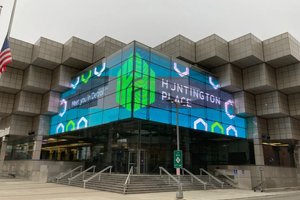
What was Cobo Hall opened its doors as one of the nation’s first mega-conference centers in 1960 and has served as a venue for sports teams, concerts, speakers, and more. In fact, on June 23, 1963, following the Detroit Walk to Freedom civil rights march, Martin Luther King Jr. delivered the original version of his “I Have a Dream” speech at Cobo Arena. Having under gone a $279 million renovation in 2015, and several name and sponsorship changes since, Huntington Place Convention Center now features a 30,000-square-foot, three-story glass atrium overlooking the Detroit riverfront, the largest ballroom in Michigan at 40,000 square feet, and 723,000 square feet of exhibit space. That’s a lot of space to maintain, and sustain. The facility also is the largest and only convention center in the world certified under LEED v4.1 Operations and Maintenance (O+M), as well as Michigan’s largest certified green LEED Building. The facility contributes 9.8 tons of unserved food to Forgotten Harvest and sends 66 tons of compost annually to Hammond Farms and also has 110 recycle bins, 10,000 square feet of green roof, five beehives that retain 10,000 bees, and numerous awards for its green efforts. How did it get here, and what can other businesses and nonprofits glean from their work in this area? Cedric Turnbore, director of operations and chair of the Huntington Place Green Committee, shares his insights on where to begin when approaching a sustainability program, the why behind it, and some examples of initiatives Huntington has put into place to date. WHERE SHOULD A BUSINESS START? #1: Form a Committee “In 2011, we developed the Green Team, a committee that includes one person from each department in the office building,” Turnbore says. “We meet regularly to review programs and goals.” The center also has a 5-person executive board established by the state of Michigan to oversee its sustainability efforts. “The board acts as our governing body that oversees and approves our programs. We work closely with them to set and manage budgets and ensure that initiatives are in the best interest of the facility, the employees, our guests, and the city.” #2: Set Attainable Goals “Start with the low-hanging fruit,” Turnbore said. “Things you can achieve in the near-term that will help to gain traction for the long haul.” Initial goals of the Green Committee in 2011 included growing the committee with representation from each department and vendor partner and organizing operations around the Green Venues Michigan certification. Since the United Nations set for 17 Sustainable Development Goals in 2015, Huntington Place has patterned its work around them. When the TCF Center Green Committee reconvened in September 2021 after a COVID-related hiatus, those goals were front and center. “This will be pivotal year for our sustainability program,” Karen Totaro, general manager TCF Center/ASM Global, said at the time. Our work in the center is to contribute to the United Nations Sustainable Development Goals and re-certify as the largest LEED venue in Michigan will be front and center for our efforts in 2022. Turnbore said so far the center has been able to implement projects contributing toward 13 of the 17 goals, and the work will continue. #3: It Takes Green to Go Green “Businesses must commit to funding for the necessary equipment, tools, and programming,” says Turnbore. “That’s why we have a board … to govern and approve our spends and ensure that those spends have the desired outcome – a return on the investment.” Some examples of investments Huntington Place has made include 110 recycling stations, food court waste diversion receptacles, visitor education posters, a green roof, receptacles for compost collection, trash compactors, a cardboard baler, and a green website page for visitor information. #4: It’s a Marathon, Not a Sprint “When we first launched our efforts 11 years ago, many individuals thought it was a fad. That the sustainability work would ‘go away. You need to have a long-term plan to ensure that it never goes away and be steadfast in your efforts every single day. It’s as simple as that,” says Turnbore. #5: Educate! According to Turnbore, for their efforts to be impactful, it’s imperative to continually educate employees, vendors, and visitors on the how and the why behind them. To that end, every new employee is trained on conservation and sustainability during onboarding. Information is posted throughout the facility. The sales and events team with vendors toward making every event as green as possible. Vendors are offered a post-event sustainability report outlining diversion data, compost data, and best practices observed during the event. Further, the team tours sustainability partner facilities to observe first-hand how their efforts are working. The committee recently toured Hammond Farms in East Lansing, which composts more than 66 tons of unused food from Huntington Place events annually. WHAT EXAMPLES DOES HUNTINGTON PLACE HAVE IN PLACE? According to Turnbore, Huntington Place’s four biggest priorities are waste diversion, energy savings, food waste management, and employee education. Here are just some of the green initiatives currently in place: Sitting off the Detroit River, Huntington Place HVAC system pumps gray water from the Detroit River through chillers that then send the cool water to various air handlers, providing cooling to zoned areas in the center. This system uses considerably less electricity than conventional air conditioning units. The Huntington Place $279 million facility upgrade incorporates numerous green building components including low-flow restroom and kitchen equipment, energy-efficient HVAC equipment, and a living green roof. Centerplate, the Huntington Place food and beverage provider collects prepared food that has not been served for pick up by Forgotten Harvest, a local nonprofit that delivers the food to pantries, soup kitchens, and shelters throughout Southeastern Michigan. Materials left by events are donated to local agencies for reuse and upcycling. Exhibit halls are equipped with induction lighting that uses 50% less electricity. All main hall lighting and heat/cool settings are computer programmed and managed. Escalators in the building are energy efficient, Kone EcoMod units. Escalators operate based on occupancy and
The Wright – Committed to Preserving African American Culture – and the Environment
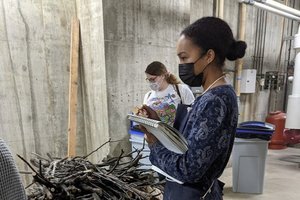
At their best, museums champion the exchange of ideas and the enrichment of intellect. As such, the Charles H. Wright Museum of African American History approaches sustainability within the context not only of preservation but also of education. The museum is at the forefront worldwide in its effort to make the work of sustainability visible in museums so that everyone can see that they have a stake in—and can contribute to—environmental preservation. The Wrights’ sustainability efforts formally took hold in 2015 upon hiring Leslie Tom, as its Chief Sustainability Officer who relocated from San Francisco by way of Arizona. Tom’s background in Architecture andInformation Management with a focus in the future of libraries, archives and museum domains were a perfect match for being the Third Cohort for a mid-career Detroit Revitalization Fellowship through Wayne State University. Of her role at The Wright, Tom says “To have the opportunity to combine my experience in environmental history and culture with the methodologies of service design and architecture and apply them at one of the oldest African American museums in the world is a dream job.” She goes on to say, The fact that the museum has a Sustainability Officer on staff illustrates its dedication and commitment to sustainability at all levels. Few museums even have this role. Under Tom’s leadership, The Wright has become a frontrunner in sustainability within the museum field. In 2019, The Wright was one of five museums to earn The Sustainability Excellence Award from the American Alliance of Museums Environment and Climate Network. Tom values the regional sustainability network and so helped to co-chair the inaugural Detroit 2030 District’s first Venue and Museums Committee. Detroit 2030 District is a part of a national movement to create high-performance building districts by reducing the environmental impacts of building. Tom points to three main areas of focus regarding the museums’ current sustainability efforts. “First is working to expand the triple bottom line [people, planet, prosperity and programs] and do what museums do well – engage learners,” she says. She gives d.Tree Studio as an example. When dying Zelkova trees were discovered on The Wright’s campus, instead of sending them to a landfill, the museum partnered with the College for Creative Studies to create d.Tree Studio – an ongoing wood shop class to explore connections between design, African American material culture/history, and sustainability. Students use the dying trees to make everything from a decolonized chess set to a fully-functioning record player. Second, is the Climate Action Framework, which The Wright museum supports through a green think tank team of museum staff, landscape architects, urban planners, designers, and community engagement plans all addressing the social and technical aspects of lowering the carbon footprint. Third, is the museum’s green work around the African World Festival. “We’ve been doing exciting green work since 2015 that’s finally being operationalized and next year will be line items in the budget,” she says. “This will include things like bike valets, recycling and compost space, sharing information at the festival and more.” She goes on to say, It’s been so satisfying to see co-creation and adoption by my colleagues and their inclinations increase toward a green institution. No one person can do it alone, and having mother nature break down silos, we’ve got support and work to do from the top down and bottom up. Some measurable initiatives The Wright has been involved with over the past several years include: The Wright’s proactive response to the August floods of 2014and increasing rain events created a collaboration with the Michigan Science Center where the result was a November 2019 convening calledRipple of Impact. Over 200 people visited our Green Stormwater Infrastructures to taste, touch, see, smell, feel the water. The Wright effectively manages nearly 19,000 gallons of stormwater each year removing 50,000 gallons of stormwater permanently from the sewer system overall. See the Stormwater Hub for more info. The Wright is continuing this work by hosting the Green Museum Town Hall with our Learning and Engagement and Sustainability Departments. Please check our website for our Green Museum Town Hall in mid-November 2022. In 2015, the museum installed Variable Fan Drives (VFDs) so museum pumps and motors do not run 24 hours per day, 7 days per week. From this effort, The Wright reduced its utility bill by $30,000. Due to green efforts around the African World Festival, The Wright has seen a 5% waste diversion rate increase, repurposed 536 pounds of recyclable material, and diverted 387 pounds of organics from landfills. A strong commitment to sustainability among The Wright’s staff has led to a 400% uptick in recycling rates on the museum campus. Of doing this work in Detroit, Tom says, “As an outsider coming into Detroit, I can say that I haven’t found another city where so much consideration and multi-generational collaboration is happening. Between the local organizations, nonprofits, and businesses the best practices coming out of Detroit are very impressive. To be working within this environment has true potential for addressing our climate crisis collectively.” When asked what project she’s most proud of, Tom says the investment made in 2019 to laser scan the entire museum building. “We now essentially have a digital twin of the building stored in the cloud, so that when we collaborate with landscape architects and engineers to invest in energy-efficient systems and more, we can upload the specs and leverage the data on how best to take care of this institution.” What’s next for The Wright? Tom says their continued work on creating a green museum of the future. “We are convening conversations and setting new standards. It’s an exciting place to be.” In closing, The Wright’s President and CEO, Neil Barclay says, “Inaction affects us all. So join The Wright as we transform spaces, hearts, and minds to make room for a more equitable future here in Detroit.” Be sure to subscribe to our newsletter for regular updates on sustainable business practices in and around Detroit.
Kerry C. Duggan Works With Game-Changing Sustainability Businesses in Detroit

SBND interviews Kerry C. Duggan,national political advisor and visionary climatech executive and former Obama White House official. Founder and CEO of SustainabiliD in Detroit, and recently named the founding director of the University of Michigan’s SEAS Sustainability Clinic, Duggan shares her thoughts on a local level, highlighting key women and businesses who are making an impact and offering advice on approaching sustainability. Duggan is a board director of Perma-Fix (NASDAQ: PESI) and a senior advisor at RockCreek. She also sits on several corporate advisory boards, including Our Next Energy (ONE), Lux-Wall, Aclima, Walker-Miller, Arctaris Impact Investors, BlueConduit, and Commonweal Ventures. She is a senior fellow at the Federation of American Scientists and a member of the International Women’s Forum. Duggan’s current public service includes serving as an appointee to the (U.S.) Secretary of Energy’s Advisory Board (SEAB) under Secretary Jennifer Granholm and to the State of Michigan’s Council on Climate Solutions under Gov. Gretchen Whitmer. Q: Kerry, please tell us about your current work. A: I started SustainabiliD five years ago. It is a woman-owned,service-disabled veteran-owned, Detroit-based diverse small business working with game-changers to equitably solve the climate crisis.So, I have no small mission statement. As such, I’ve spent the last five years working on climate solutions in two ways: On the institutional side, I’m working to help develop the business model around place-based work for larger organizations. I have been appointed as the founding director of UM’s SEAS sustainability clinic in Detroit, and we are currently focused on three goals: To seek equitable and just solutions to the city’s most pressing sustainability-related issues; to lower operating costs—particularly in energy management for city operations—while reducing carbon emissions; and to support the delivery of services directly to the city and, through partner programs, to improve residents’ quality of life. Second, I work with climate solution companies. These are the game-changers. For example, Our Next Energy (ONE) recently set a world record of EV miles traveled on a single charge: 752 miles, in December, in Michigan. This is a very big deal. I work to help these businesses navigate opportunities to scale with the speed that we all need to combat the climate crisis. Q: Your work is largely around energy, climate, and environment.Where does your passion in these areas come from? A: First, I’m a mom. Climate is the most urgent issue of our time, and I want to create a safer, more sustainable planet for the next generation. Second, I have always loved doing my work in Detroit. My ancestors immigrated to Detroit from Ireland, so from a generational perspective, I try to give back to the place that has given my family so much. In this way, I’m very grounded in Detroit. I was also blessed to spend many summers of my youth on the shores of the Great Lakes, home to 21% of the world’s fresh surface water. How lucky are we? I work to protect that and make it available for my kids. Lastly, I have a basketball background, and the skills I gleaned from playing high-level hoops have transferred to my work. I’ll give an example. There is a move in basketball called the ‘give-and-go move’ where you give the ball away, then cut to the net, and get the ball back to make the lay-up. In my work, I listen to the needs of leaders in communities, putting aside my point of view, because if I don’t listen to real and immediate needs, we are just talking past one another – and no one wins. I put the give-and-go into practice in this way a lot. Q: What is your vision behind SustainabiliD? A: I grew up in a suburb of Detroit. Kids twenty miles down the road living in the city of Detroit faced injustices that I did notand conversely did not have the opportunities I had. That’s been my charge: how can we change this and ensure the city is not only vibrant and safe but also offers equitable opportunities to everyone? Q: The SustainabiliD team is predominantly women. What are your thoughts on women as leaders in sustainability? A: I think if I created a pie chart of my calendar, we’d see that daily I’m mostly speaking with female leaders across the globe, who are mostly non-white. These are the voices that have been left furthest behind in every conversation to date on the planet. I know I don’t have all the answers, but I always try to listen to people of color, women, other minorities, and people with underrepresented identities on what their needs are and try to help them position themselves to win the future. That’s where I’ve chosen to spend my time. Q: Speaking of women, what Detroit female business leaders in the sustainability space can you point to who are making a difference? A: Carla Walker-Miller. I work with a variety of companies but one that is an absolute stand-out is Walker-Miller Energy Services. In addition to what they do, which is to help relieve folks of energy burden by doing energy retrofits, Carla is an equitable economic development leader and a woman of color. I admire her not only for her company’s work but for her leadership. She is a national figure living and working in Detroit making a great impact on equitable economic development. Her work constantly informs what I’m doing now. Carla Walker-Miller has hired Dr. Brandy Brown as Chief Innovation Officer for Walker-Miller. She is another amazing talent. Before joining Walker-Miller, Dr. Brown served as Climate & Energy Advisor within the Michigan Department of Environment, Great Lakes & Energy. She also serves as part of the Environmental Justice faculty for the University of Michigan’s School for Environment and Sustainability and as an appointee to Michigan’s National Resources Trust Fund Board. A native Detroiter, Dr. Jalonne L. White-Newsome was recently tapped to be the new White House Council on Environmental Quality’s Senior Director for Environmental Justice. She has tackled environmental challenges from a wide range