

Rebuilding Electric Motor Manufacturing in Michigan
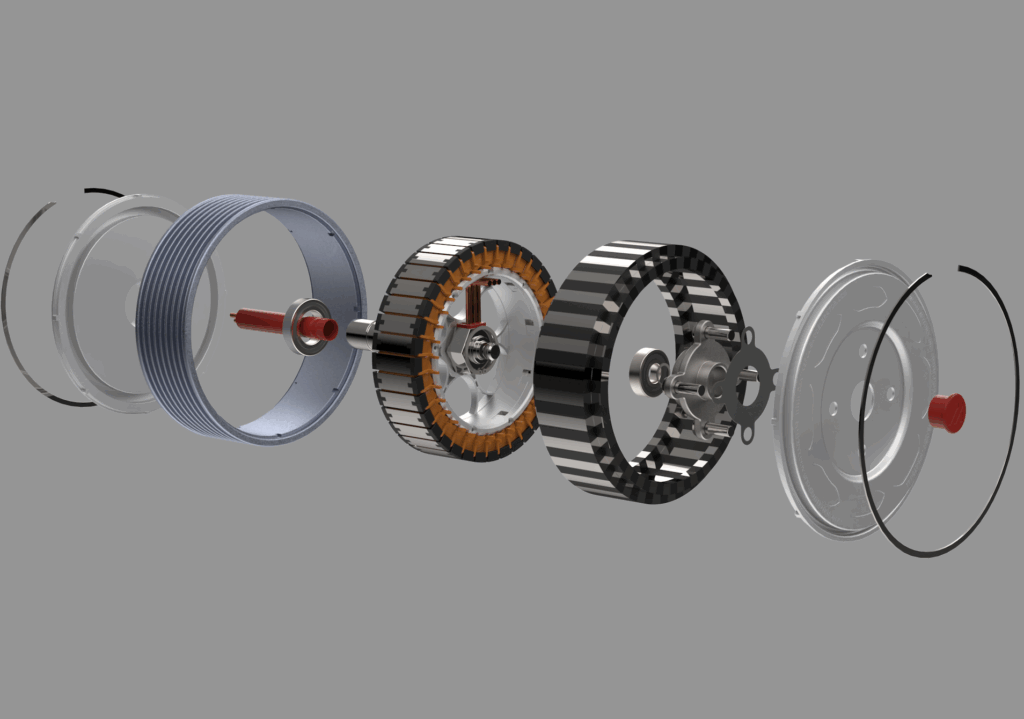
Farmington Hills-based Modal Motors designs and manufactures next-generation electric motors engineered for high torque density, simplified assembly, and scalability in the United States. The company’s transverse-flux architecture reduces reliance on rare-earth materials while improving efficiency and performance across mobility applications, including EVs, drones, and industrial equipment. By rethinking both motor design and manufacturability, Modal Motors aims to strengthen domestic supply chains and support the growing electrification industry. The company recently raise $2 million in a seed funding round that it will use to accelerate its transition from R&D and prototyping to full-scale manufacturing in Michigan. SBN Detroit interviewed company founder and CEO Michael Steenburg about reshoring manufacturing, supporting Michigan’s EV leadership, and the future of electric propulsion. Q: Give us the brief origin story. What motivated the creation of Modal Motors? A: Over the last 25 years, American manufacturing has moved steadily overseas. As electrification has accelerated, we’ve seen a slow-moving shift where innovation happens here, but production doesn’t. Early in my career, I focused on improving fuel efficiency in vehicles. That eventually led to developing my own motor IP. When I looked at the manufacturing reality, it was clear: If we wanted the U.S. to truly compete in electrified mobility, we needed to rethink how motors are built. Instead of designing motors that require extremely labor-intensive processes and then shipping production to Asia to reduce costs, we asked: What if we design motors that are simpler and more affordable to build here in the U.S. from the start? Modal Motors is about empowering a domestic ecosystem — not just for cars, but also for tools, industrial equipment, and new sectors like drones. We want to help restore middle-skill manufacturing jobs and global competitiveness. Q: As the EV transition accelerates, what strengths can Michigan leverage in next-generation motor technology? A: Michigan is uniquely positioned to lead in electric motors. We already have the materials: Magnets, copper, aluminum, and magnetic steel — all core materials for electric machines. We have the fabrication capabilities and the workforce tuned to advanced manufacturing. The state has done this before. During WWII, Michigan transformed its industrial capacity seemingly overnight. When you combine supply chain + skilled labor + materials, Michigan can support EVs from raw resource to finished motor. Q: Your motors use a transverse-flux architecture. What limitations of conventional motors drove that change? A: Traditional motors are built from dozens of wound poles — for example, 36 windings, each requiring extremely precise tolerances. In EV motors, the most important factor is the air gap between rotor and stator. Every tolerance stack-up tightens that gap, making efficiency dependent on expensive precision manufacturing. That’s where the U.S. loses cost competitiveness. Either you buy extremely complex machinery or you rely heavily on manual labor, and both increase cost. We simplified the architecture. Our drone motors have about 10 components. Fewer parts means faster assembly, fewer labor hours, and lower costs — while allowing us to pack in more conductive material like copper, which directly boosts efficiency. We also design for improved heat removal, which is critical because permanent magnets degrade if they overheat. It’s not magic. It’s applying well-understood engineering principles to reshape manufacturability. Q How does torque density influence vehicle performance and design flexibility? A: Higher torque density means more power in a smaller package. That gives automakers more freedom — lighter powertrains, more cabin space, and better range due to reduced mass. It also lets us rethink where motors go. You can decentralize propulsion — wheel motors are a great example — and that opens new possibilities for efficiency and architecture. Q: What role do motor efficiencies play in lifecycle sustainability? A: Once an EV is in use, there are no tailpipe emissions. Lifecycle emissions are determined by everything leading up to that point — and the more efficient the motor, the faster you reach carbon parity with internal combustion. The energy pathway matters too. Electricity can be generated cleanly and used directly in propulsion with relatively little loss. That’s fundamentally different from extracting, refining, transporting, and burning fuel. And increasingly, people are powering their vehicles at home with solar — something impossible with fossil fuels. Q: What makes a motor truly “greener” end-to-end? A: Cradle to grave matters. How materials are mined. How they’re processed. How much waste is generated. We design for net-shape molding, which means essentially zero scrap — compared to stamped laminations where 40–60% of material can become waste. Even if metal is recycled, that still requires energy. Eliminating waste helps both sustainability and cost, which reinforces competitiveness for U.S. manufacturers. Q: Where do you see your earliest applications? A: Right now, off-highway vehicles, low-speed on-road vehicles, and especially drones. We’ve seen enormous demand in aerospace and defense because propulsion reliability and supply-chain security are strategic priorities. Drones were the first to fully embrace emerging motor architectures. Q: How open are OEMs to integrating new propulsion architectures? A: It varies. Drone manufacturers are agile — they don’t have decades of legacy powertrain design to work around. Automakers are more cautious, but they’re increasingly interested in wheel-motor architectures because removing the centralized drivetrain frees up vehicle space and simplifies mechanical systems. There’s also a generational shift. Younger buyers are embracing smaller, more efficient vehicles. That shift aligns well with distributed propulsion. Q: What breakthroughs do you expect next in electric motor development? A: I see two major drivers. First, new materials. AI-accelerated materials science will unlock stronger, cooler-running, more recyclable magnetic and structural alloys — including non-rare-earth alternatives. Second is new manufacturing automation. Robotics — including humanoid robots — will soon handle complex manual steps at high speed and precision, enabling U.S. factories to operate 24/7. When you combine those, motor technology and production are both heading toward dramatic gains in efficiency and sustainability. Be sure to subscribe to our newsletter for regular updates on sustainable business practices in and around Detroit.
Commercial Fleet Vehicle’s Evolution to Electrification
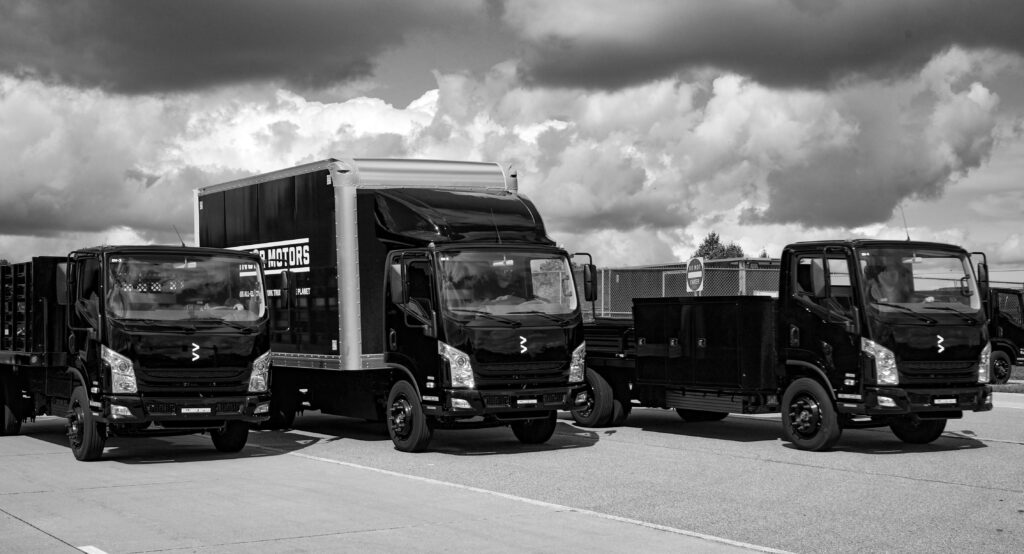
Bollinger Motors is an electric vehicle manufacturer focused on Class 4 and Class 5 trucks. Founded in 2015, the company initially set out to develop off-road electric vehicles but later pivoted to commercial fleet electrification, seeing a gap in the medium-duty truck market. Now headquartered in Oak Park, Michigan, Bollinger is majority-owned by California-based Mullen Automotive (Nasdaq: MULN). SBN Detroit interviewed Jim Connelly, the company’s Chief Revenue Officer, to discuss the challenges and opportunities within the Class 4 and Class 5 electric truck market, the considerations driving fleet electrification, and the broader implications for sustainability and economic growth in the region. Q: How did Bollinger Motors get started, and what led the company into the Class 4 and 5 truck market? A: Robert Bollinger founded Bollinger Motors in 2015 in upstate New York with the goal of developing a rugged, off-road vehicle for his farm that didn’t rely on gas. He and a small team of engineers started experimenting in his garage. As things progressed, Robert saw a gap in the commercial truck space – there were virtually no electric options in the Class 4, 5, and 6 segments. With government incentives accelerating EV adoption, the opportunity to focus on the commercial market became clear. Bollinger moved operations to Oak Park in 2017, tapping into the automotive engineering and manufacturing expertise in Detroit. Q: What is the driving force behind the development of Class 4 and 5 trucks, and how does this market function? A: The commercial vehicle sector has been expanding rapidly, particularly with the rise of last-mile delivery services and the increasing demand for residential delivery. Class 4 and 5 trucks are utilized across several industries, including landscaping, telecommunications, and delivery services. These versatile vehicles play a key role in urban and regional transportation. Electrification makes perfect sense for this market. Most Class 4 and 5 vehicles operate locally, returning to a central depot each evening, which simplifies charging logistics. The predictable routes and relatively moderate daily mileage make them ideal candidates for EV adoption. Q: What are the main factors driving businesses to transition to electric trucks at this size? A: Sustainability goals are a major motivator. Large corporations are looking to reduce their carbon footprint, and transitioning their fleets from gas and diesel to electric clearly aligns with their environmental objectives. Cost savings are a key factor as well. Fuel economy improvements, lower maintenance costs, and federal and state incentives make electric fleet adoption financially appealing. Since these vehicles are driven extensively, reducing fuel costs and minimizing maintenance expenses significantly lower the total cost of ownership over time. Q: What are the biggest challenges and opportunities in establishing EV adoption in this segment? The biggest challenge is infrastructure development. Companies need to build charging infrastructure to support EV fleets, which can be a major hurdle. Another challenge is driver familiarity. Drivers are used to gas and diesel vehicles, so transitioning to EVs can be disruptive. We intentionally designed the truck’s cab and controls to be similar to traditional vehicles. When it comes to opportunities, the market is wide open. Q: How does Bollinger’s partnership with EO Charging support fleet electrification? A: While many companies are eager to transition to electric fleets, most fleet managers have spent their careers managing gas and diesel vehicles. The shift to EVs requires new knowledge about charging infrastructure, vehicle compatibility, and grid capacity – areas that can cause angst. EO Charging provides end-to-end solutions, assessing customers’ facilities, infrastructure, and utility needs. They work alongside us to ensure that everything is in place – from hardware installation to liaising with utility companies – so businesses can confidently move forward with EV adoption. Q: What has the response from fleet operators been since Bollinger launched sales last fall? A: The response has been very positive. At the recent NTEA Work Truck Show, we participated in ride-and-drive events, where industry leaders and fleet managers had the opportunity to test our vehicles. Many have since expressed strong interest in long-term test drives, which we are now scheduling. We’ve also established a growing dealer network, with over 50 locations nationwide and are continuing to expand. Discussions with additional dealer groups indicate that demand for electric commercial trucks is rising steadily. Q: How do these trucks compare to diesel alternatives in cost and emissions? A: The total cost of ownership varies depending on several factors, including miles driven, fuel prices, vehicle lifespan, and upfitting requirements. We use a tool developed by Argonne National Laboratory at the University of Chicago, which allows businesses to calculate the payback period and emissions reductions for their specific use case. While EVs have a higher upfront cost, they become more cost-effective over time due to fuel savings, reduced maintenance, and substantial government incentives. Speaking of incentives, the federal government offers a $40,000 tax credit for Class 4 EVs under the Inflation Reduction Act. Certain states, such as California, provide additional incentives of up to $60,000 per vehicle, meaning businesses can receive up to $100,000 in incentives per truck. These incentives make early EV adoption much more financially viable. Many states now offer additional grants and rebates as well. We have a dedicated team that helps customers navigate these incentives, ensuring they maximize available savings. Q: What role does Bollinger’s Michigan headquarters play in the future of EV truck production? A: Robert Bollinger always knew that to scale, he needed to be in Detroit – the automotive capital of the world. Southeast Michigan provides access to a highly skilled workforce, manufacturing expertise, and a network of suppliers and engineers that is unmatched anywhere else in the country. We see ourselves as more than just an EV company – we are an automotive company. Being headquartered in Michigan allows us to merge cutting-edge technology with traditional automotive craftsmanship, ensuring we produce world-class electric trucks that meet the needs of commercial fleets today and into the future. Be sure to subscribe to our newsletter for regular updates on sustainable business practices in and around Detroit.