
LAPRISHA BERRY DANIELS IS EXECUTIVE DIRECTOR OF DETROITERS WORKING FOR ENVIRONMENTAL JUSTICE AND A LEADERSHIP COMMITTEE MEMBER FOR SUSTAINABLE BUSINESS NETWORK DETROIT
DWEJ’s vision for sustainability is rooted in the three pillars of sustainability: health and happiness of community members, a healthy local environment free from hazards and harm, and economic vitality.
As an organization that focuses on environmental justice and strives to have the voice of the community-centered as decisions are being made that impact their health (physical, mental, spiritual, and economic), we assert that community members can envision and create healthy communities that meet their immediate and distal needs.

A healthy community is one in which all systems work together to support the health and well-being of all its members. Local businesses are part of the community’s ecosystem and thus play a unique role in supporting the health and well-being of the community. Ideally, the relationship between community members and local business is mutually beneficial as they prioritize health and co-create a healthy community. Local businesses and community members can work together to identify threats to community well-being and create strategies to address challenges.
In Detroit, and beyond, climate change threatens our ability to achieve and maintain physical, mental, spiritual, and economic health. As we experience more extreme weather locally, such as extreme heat and annual “100-year floods”, we recognize that our built environment may not be able to weather the storm (pun intended). Unfortunately, our existing residential housing stock and current construction practices are too often ill-suited for current and future climate conditions. The mismatch between what is available and what is needed creates threats to the health of people and planet.
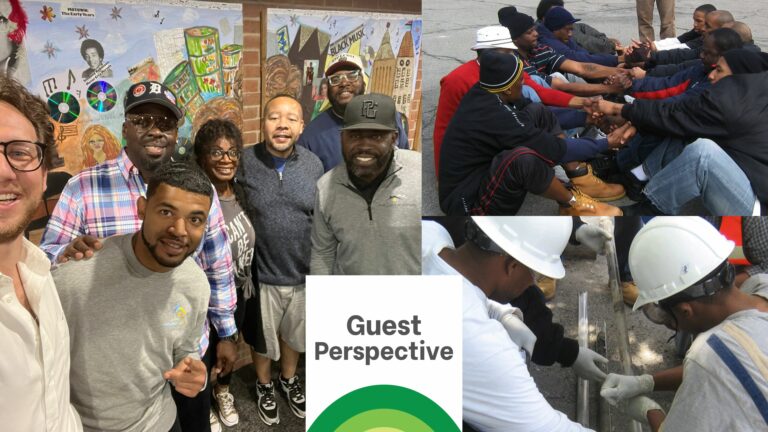
DWEJ developed a contractor accelerator program that focuses on contractors increasing their awareness about ways to improve the built environment to mitigate risks related to climate change while centering sustainability. DWEJ’s contractor accelerator program, Building Health, serves as an incubator to support peer-to-peer learning among Detroit-based, Detroit-serving contractors of color. Building Health increases contractors’ awareness and implementation of “environmentally responsible and resource-efficient” practices that have:
Building Health increases contractors’ understanding of the impact they can have on health. For example, participating contractors are presented with strategies for upgrading and greening residential housing in ways that include the use of various building methods and materials that can make homes more energy efficient. These improvements decrease greenhouse gas emissions, improve the health and comfort of the home, and improve the economic health of the occupants by reducing the cost of utility use. Participants receive financial and technical assistance to implement practices as part of the program as well. Additionally, contractors learn how to best communicate the benefits of sustainable repair and rehab practices to clients.
The role of local contractors is just one example of the opportunity our community has to transform our ecosystem and economy for the better. There is a unique and distinct role that local business plays in supporting people and planet. Sustainability is an iterative process where we must work collectively toward the goal of having healthy and vibrant places in which to live, learn, work, play, and pray.
—
Check out Laprisha Berry Daniels’s recent TEDTalks: Lessons from the Past on Adapting to Climate Change
Be sure to subscribe to our newsletter for regular updates on sustainable business practices in and around Detroit.



In November 2023, the City of Detroit enacted an Energy and Water Benchmarking Ordinance requiring buildings 25,000 square feet and larger to annually report their energy and water usage to the city. The policy focuses on transparency, giving building owners and city leaders insight into how buildings perform and where opportunities may exist to improve efficiency and reduce costs. SBN Detroit interviewed Maria Galarza, Deputy Director of the...
Detroit-based nonprofit Elevate focuses on the intersection of energy equity, housing stability, and workforce development. Through community partnerships and programs that connect residents with energy-efficiency upgrades, education, and job-training opportunities, the organization works to strengthen neighborhoods while helping families reduce costs and improve living conditions. SBN Detroit interviewed Shawna Forbes Henry, Director of Community Programs at Elevate, about the broader implications of energy access, the structural barriers communities...

The Green Business Lab, founded in 2002 by Samantha Svoboda, aims to help organizations strengthen decision-making about sustainability through immersive business simulations and strategic advisory services. Working with leadership teams across industries, the Lab creates structured environments where executives can explore how environmental, operational, and market forces intersect with core business strategy. Over more than two decades, the Green Business Lab has worked with companies toward moving sustainability...