

Pollinators are essential to Michigan’s ecosystems, food systems, and long-term environmental resilience — yet they face increasing threats from habitat loss, pesticides, disease, and climate change. As Southeast Michigan looks for scalable, science-based approaches to ecological stewardship, the University of Michigan-Dearborn has emerged as a voice in pollinator conservation, sustainability, and community education.
SBN Detroit interviewed Dr. David Susko, Associate Professor of Biology and Chair of Biology in the Department of Natural Sciences at UM-Dearborn, about the university’s Bee Campus USA affiliation, the initiatives underway on and beyond campus, and why the region is positioned to advance pollinator health.
Q: What role does Bee Campus USA play at UM-Dearborn?
A: First, it’s important to distinguish Bee City USA from Bee Campus USA. They share a common mission, but Bee Campus USA focuses specifically on higher education institutions. Both programs create a national framework — and a third-party certification — that helps cities and campuses advance pollinator education, habitat management, and long-term preservation.
For us, the affiliation established a baseline. It gave us a structured way to track what we were already doing, identify gaps, and strengthen our commitment to pollinator health. It also connects us to a national network so we can benchmark progress, share strategies, and stay accountable. In many ways, it formalized work that had been happening here for decades.
Q: What concrete steps has the university taken to support pollinator health, biodiversity, and sustainable landscapes?
A: Many of our efforts predate the certification. UM-Dearborn has had an organic community garden since the 1970s and a strong environmental stewardship culture. Since I joined the campus in 2003, we’ve expanded those efforts significantly.
We’ve added pollinator gardens and rain gardens, managed a campus bee yard for several years, and partnered closely with our facilities and grounds teams. They’ve been instrumental — reducing pesticide use, transitioning to organic fertilizers, and designating additional “no-mow” or naturalized areas on campus. These provide habitat for insects, reduce emissions from mowing, lower maintenance costs, and support overall soil and ecosystem health.
Q: What challenges have you encountered in implementing pollinator-friendly landscapes?
A: The biggest challenge is cultural. People often equate “well-maintained” with “closely mowed.” A pollinator-friendly landscape looks different — and sometimes that difference requires explanation.
These spaces aren’t unkempt; they’re functioning ecosystems. Naturalized areas improve biodiversity, reduce fertilizer use, cut emissions, and support wildlife. Part of our work is helping people reframe what beauty looks like in a sustainable landscape. Once they understand the ecological benefits, they usually become strong supporters.
Q: How are students, faculty, and staff involved in these initiatives and what types of engagement have you seen?
A: Engagement is one of our greatest strengths. The Environmental Interpretive Center (EIC), which opened in 2001, draws thousands of visitors each year for free programming related to ecology, natural history, and pollinators. We host workshops, seasonal programs, and young naturalist sessions. These opportunities reach not only students, but families, K-12 classes, and community members.
We also offer volunteer stewardship events — “Stewardship Saturdays” — where participants help remove invasive species and restore habitat quality. These have become incredibly popular.
And at an academic level, pollinator initiatives are woven into coursework, research, and capstone projects. For many students, this becomes their first real stewardship experience. They see how their work directly contributes to the regional ecosystem and realize the role they can play in addressing pollinator decline.
Q: Can you share an example of how sustainability and pollinator conservation intersect with experiential learning or research on campus?
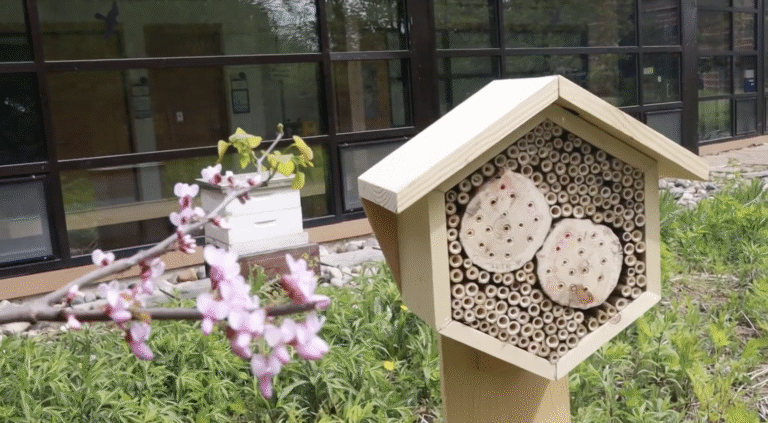
A: A great example is the PolliNation Project, which began when a student approached me wanting to take more action. Ultimately, this became a campus and community-wide initiative to build insect hotels in order to promote pollinator awareness and conservation.
Insect hotels are like birdhouses for pollinators. Our students built and distributed roughly 250 of these hotels across the region.
We worked with the College of Engineering and Computer Science, part of which is a design course where students develop apps for real-world stakeholders. The students ended up creating two digital tools: the PolliNation ID App, which helps users identify species, and the PolliNation Hotel App, which tracks locations and resources for “insect hotels.”
The project earned a Ford College Community Challenge (C3) Grant and inspired broader outreach. Rescue Michigan Nature Now donated additional hotels, and our apps and online materials help residents build their own.
This is what experiential sustainability education should look like — students creating tools with real ecological and community impact.
Q: What value do these efforts bring beyond the campus borders, especially to Detroit-area communities?
A: Our work extends into the region in several ways. The PolliNation Project has been integrated into the Rouge River Gateway Trail through interpretive signage, giving visitors a deeper understanding of pollinators. Our online resources help residents and community groups design their own pollinator habitats.
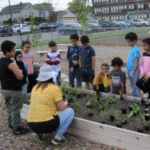
We also collaborate with Detroit-based partners. For example, the Dearborn Shines initiative brings schoolyard gardens — including pollinator beds — to local schools. Students learn about nutrition, ecology, and pollinators simultaneously. UM-Dearborn students helped design and build these spaces, creating a powerful feedback loop of education, stewardship, and hands-on impact.
Q: Detroit and Southeast Michigan have a unique ecological and urban history. Why is Bee Campus designation meaningful here?
A: This region carries both ecological richness and environmental challenges. We have hundreds of native bee species in Michigan alone, many of which rely on the exact types of habitats we’re restoring. At the same time, urbanization and habitat fragmentation make pollinator conservation more urgent.
Being a Bee Campus in this context means modeling what sustainable land stewardship looks like in a northern, urbanized ecosystem — and showing that cities and campuses can play a leadership role in ecological recovery.
Q: What challenges and opportunities does Southeast Michigan’s climate present for pollinator protection?
A: Overwintering is a major issue. Honeybees struggle in northern climates, and climate variability makes conditions more unpredictable. Beekeepers in Southeast Michigan are experimenting with improved insulation techniques to help colonies survive.
At the same time, industrialized beekeeping has created its own pressures. Commercial hives migrate across the country for crop pollination — almonds in California, apples and cherries in the Northwest, and so on. This movement spreads disease and stresses colonies.
The opportunity lies in strengthening habitat for native bees. They are diverse, resilient, and essential — and we’ve identified dozens of species on our campus alone.
Q: Looking ahead, how do you see UM-Dearborn’s role in regional sustainability evolving?
A: We’re aligning with university-wide goals on carbon reduction, naturalized landscapes, and sustainable operations. The next step is improving our metrics — measuring carbon emissions, water use, fertilizer application, naturalized acreage, and educational outputs. Bee Campus USA provides an outstanding reporting structure for this.
We were the first public institution in Michigan to receive Bee Campus certification. Now, with Ann Arbor also affiliated, we’re building a system-wide model. The biggest advantage we have is contact with young people. They’re not cynical — they’re energized. When students build insect hotels, develop apps, or design pollinator gardens, they see immediately that they can shape the future.
Our role is to support that passion, provide scientific grounding, and help scale the impact. These projects not only restore habitat — they build hope.
Be sure to subscribe to our newsletter for regular updates on sustainable business practices in and around Detroit.




In November 2023, the City of Detroit enacted an Energy and Water Benchmarking Ordinance requiring buildings 25,000 square feet and larger to annually report their energy and water usage to the city. The policy focuses on transparency, giving building owners and city leaders insight into how buildings perform and where opportunities may exist to improve efficiency and reduce costs. SBN Detroit interviewed Maria Galarza, Deputy Director of the...
Detroit-based nonprofit Elevate focuses on the intersection of energy equity, housing stability, and workforce development. Through community partnerships and programs that connect residents with energy-efficiency upgrades, education, and job-training opportunities, the organization works to strengthen neighborhoods while helping families reduce costs and improve living conditions. SBN Detroit interviewed Shawna Forbes Henry, Director of Community Programs at Elevate, about the broader implications of energy access, the structural barriers communities...

The Green Business Lab, founded in 2002 by Samantha Svoboda, aims to help organizations strengthen decision-making about sustainability through immersive business simulations and strategic advisory services. Working with leadership teams across industries, the Lab creates structured environments where executives can explore how environmental, operational, and market forces intersect with core business strategy. Over more than two decades, the Green Business Lab has worked with companies toward moving sustainability...