
The Green Business Lab, created by Samantha Svoboda, is a sustainability-focused simulation designed to help businesses tackle real-world challenges while measuring success through the Triple Bottom Line: People, Profit, and Planet.
By immersing participants in scenarios that reflect real-world complexities, the lab aims to help organizations across various industries identify sustainability opportunities, develop actionable strategies, and drive meaningful change.
SBN Detroit interviewed Svoboda to explore the pressing sustainability challenges businesses face and how tools like The Green Business Lab aim to address these gaps in a practical, results-driven way.

Q: What inspired you to create a business simulation focused on sustainability?
A: The inspiration began decades ago when I was finishing my MBA at the University of Michigan. I wanted to focus on environmental work. I met Professor Stuart Hart and worked with him for several years to start what is now called the Erb Institute.
As I collaborated across disciplines at U of M I saw a major opportunity. Sustainability requires collaboration, however. Various disciplines and schools each had their own style, specialized knowledge, and vocabulary. Through this work, I realized we needed a way to bring people together to have meaningful conversations about sustainability.
Later, when teaching at Georgetown University, my students pointed out that most of the case studies we were using highlighted the weaknesses in existing sustainability practices, not successes.
These, and other conversations, helped me to clarify my mission – creating a tool that could simulate real-world challenges, uncover perspectives, and foster collaboration.
The Green Business Lab is the result: a customizable experience that helps companies and individuals tackle sustainability issues in a tangible, positive, actionable way, enabling them to focus on people, profit, and planet.
Q: How does the business simulation work?
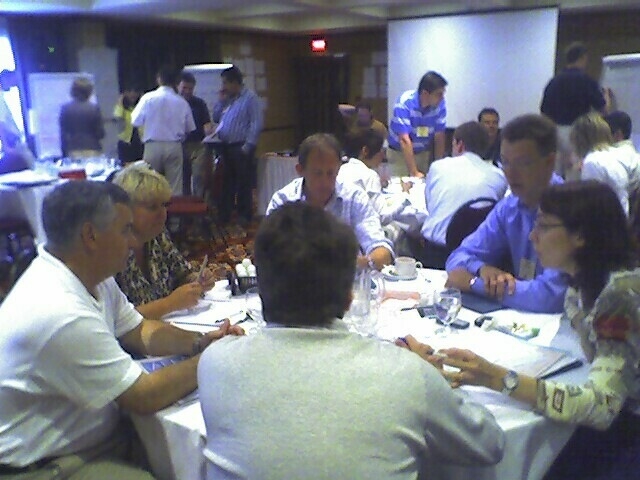
A: The Green Business Lab operates like a flight simulator for business sustainability, offering participants a dynamic and immersive learning experience. Participants form executive teams and are tasked with leading fictional companies within an industry resembling real-world sectors like transportation or mobility products. Their mission: to achieve financial, environmental, and social goals aligned with the triple bottom line.
Throughout three business cycles, participants make critical decisions on product design, operations, technology, marketing, distribution, customer use, and end-of-life processes. Each choice is tagged with Sustainable Development Goals (SDGs), and teams must navigate leadership challenges involving environmental and social issues. They receive detailed reports on financial performance, environmental impact, and social assessments.
Teams present their vision, strategies, and outcomes during engaging, facilitated debrief discussions. They develop written plans for how to apply what they have learned to their work. By simulating real-world scenarios, participants develop practical decision-making skills, align sustainability goals with business strategy, and gain insight from diverse approaches taken by competing teams.
Q: What are the specific challenges or gaps in business education that you see?
A: Sustainability requires navigating some potentially thorny nuances. Participants bring deeply ingrained perspectives, assumptions, experiences, and knowledge about sustainability to the table. This can make discussions complex and sometimes emotional. As I have observed teams over the years, I’ve realized these perspectives need to be shared and addressed for a team to come to a common understanding of how to proceed. It is like going slow to go fast. It can take time to reach a shared mindset, but once the work is done, progress is generally rapid.
Additionally, sustainability is vast in scope. Over the years, the focus has expanded from issues like ozone depletion to plastics in our oceans, climate change, biodiversity, and social equity. It impacts every aspect of business – supply chains, operations, technology, marketing, governance, and stakeholder engagement.
The Lab strives to address these challenges by providing a transparent and comprehensive experience that accommodates diverse perspectives. It’s designed to help participants understand the interconnectedness of sustainability issues while fostering discussions that move beyond surface-level understanding.
Q: What are the most common sustainability challenges organizations face when participating in the Lab?
A: Every company has unique challenges based on its industry and business model. For example, a coffee company like Starbucks might focus on how climate change threatens its supply chain, while a consumer electronics company may focus on product durability, repairability, and circularity.
At a high level, many companies use the lab to build awareness and get their arms around sustainability and how to approach it in a holistic way. They also use it to signal that sustainability is a priority. And finally, it’s an opportunity for leadership to gather feedback from participants about perceived challenges and opportunities within the organization.
Q: What kinds of strategies or insights have emerged from participants?
A: One powerful example involved a company whose business model encouraged rapid product turnover, which inherently led to increased waste. During the simulation, participants recognized the disconnect between their business model and their sustainability goals, sparking a critical conversation about how to reconcile these competing priorities.
Another insight relates to the triple bottom line – financial, environmental, and social metrics. Many participants come into the lab expecting a formulaic approach to sustainability, where they can calculate and compare certain outcomes. What they often realize is that sustainability requires balancing competing priorities and working collaboratively to find high-leverage solutions.
Q: How does engaging with real-world examples impact participants’ understanding of sustainability?
A: Real-world examples provide context and clarity. These examples help participants see the practical implications of their decisions.
At the end of the simulation, teams present their strategies and outcomes. Despite starting with the same information, each team often arrives at different conclusions. This diversity of thought demonstrates that there are multiple pathways to sustainability, and the key lies in identifying the opportunities that align with a company’s values and stakeholder priorities.
Q: What do you see as the biggest barriers preventing businesses from fully embracing sustainability practices?
A: One major barrier is the lack of clear roadmaps. Sustainability is a broad and complex topic, and many organizations struggle to define what “fully embracing” it even looks like. Additionally, sustainability requires a shift in mindset and a willingness to engage in difficult, nuanced conversations. It’s not enough to nod in agreement during presentations – the real challenge lies in implementation.
Another challenge is time. The Lab takes about 12 – 15 hours to complete (although the timing is flexible and can be asynchronous), which is a significant commitment. However, meaningful conversations and impactful learning experiences require this level of depth. Sustainability isn’t something that can be fully addressed in a one-hour workshop—it requires deliberate effort and engagement.
Be sure to subscribe to our newsletter for regular updates on sustainable business practices in and around Detroit.


In November 2023, the City of Detroit enacted an Energy and Water Benchmarking Ordinance requiring buildings 25,000 square feet and larger to annually report their energy and water usage to the city. The policy focuses on transparency, giving building owners and city leaders insight into how buildings perform and where opportunities may exist to improve efficiency and reduce costs. SBN Detroit interviewed Maria Galarza, Deputy Director of the...
Detroit-based nonprofit Elevate focuses on the intersection of energy equity, housing stability, and workforce development. Through community partnerships and programs that connect residents with energy-efficiency upgrades, education, and job-training opportunities, the organization works to strengthen neighborhoods while helping families reduce costs and improve living conditions. SBN Detroit interviewed Shawna Forbes Henry, Director of Community Programs at Elevate, about the broader implications of energy access, the structural barriers communities...
The Green Business Lab, founded in 2002 by Samantha Svoboda, aims to help organizations strengthen decision-making about sustainability through immersive business simulations and strategic advisory services. Working with leadership teams across industries, the Lab creates structured environments where executives can explore how environmental, operational, and market forces intersect with core business strategy. Over more than two decades, the Green Business Lab has worked with companies toward moving sustainability...