

For two-plus years, Dr. Tony G. Reames was a Biden-Harris Administration presidential appointee, working in energy justice. Most recently he served as the Principal Deputy Director for the Office of State and Community Energy Programs at the U.S. Department of Energy (DOE).
Now, he returns to the University of Michigan – where had worked as a research fellow – becoming the Tishman Professor of Environmental Justice and serving as the new Director of the School for Environment and Sustainability (SEAS) Detroit Sustainability Clinic.
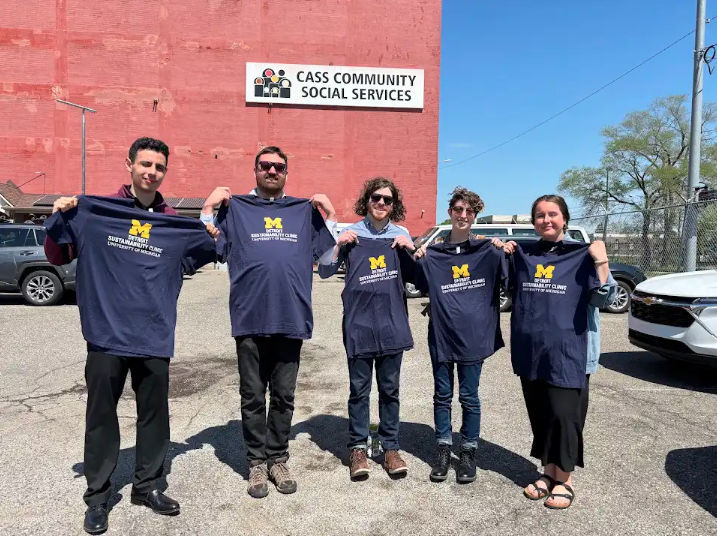
Through support from the Kresge Foundation, the clinic was founded in 2021 to build long-term capacity and partnership in Detroit, and to connect residents, nonprofit organizations, businesses, and city government to its resources.
Reames sat down with SBN Detroit to discuss this new role, the work of the clinic, and how it involves and impacts businesses in Southeast Michigan.

Q: What is the impetus behind the clinic?
A: The Detroit Sustainability Clinic came into existence based on the recognition that the several faculty in the School for Environment and Sustainability had projects with community-based organizations, government, and business partners in the city that we were approaching in silos.
Operating together as a clinic allows us to more cohesively engage with community partners and approach these projects in a more efficient and effective way.
Our mission is to be a hub for advancing sustainability and climate action in an equitable and just way. We want to foster long-term relationships with community-based organizations, local governments, and businesses in Detroit to support their sustainability and climate efforts from ideation to implementation.
Q: What differentiates the work the clinic does from that of other national or local initiatives in the space?
A: We want to be both additive and complementary.
Also, what is unique about what we provide is that we can bring the full resources of the university to support sustainability and climate action in communities, centered on equity and justice.
We have the opportunity to not only use our research and data but to also boost capacity for community-driven efforts through our students and faculty.
Q: How does sustainability feature in the work the clinic does?
A: Sustainability for me is recognizing the social, environmental, and economic impacts of the current climate crisis and how we use the research, teaching, and other resources of the University in deep collaboration with our community partners to support a community’s long-term existence. It’s the triple bottom line.
We bring these aspects together to help communities with solutions-driven planning and implementation
Q: Given the focus on Detroit communities, how does the Detroit Sustainability Action Agenda feature in the work the clinic is doing?
A: I participated in planning efforts to develop the city’s Sustainability Action Agenda and Climate Strategy and the Detroit Climate Action Plan. These plans are the foundation for the areas of focus for the clinic. The Detroit Office of Sustainability is a clinic partner, and we have funding to work with the city to implement its climate strategy and Blight to Beauty Initiative. Supporting local sustainability and climate action is the core of what we do.
As the clinic expands, I look forward to working with other local governments in Southeast Michigan to create and implement their sustainability and climate action plans.
Q: How do you plan to involve and work with businesses in Detroit?
A: I’ve been working with folks in Detroit for about ten years and the ingenuity in this city stands out. I’ve spent a good amount of time with entrepreneurs and start-ups that are working on new technology and other ways to help households operate more sustainably.
I see the clinic acting as a conduit between businesses that have these technical solutions and communities that need these solutions.
As a university, we also have this amazing opportunity to develop the next generation of the sustainability and climate workforce.
Q: How do you think that impacts businesses in Southeast Michigan?
A: I believe that exposing students to real-world challenges makes them better employees for the business and organizations they’ll go to work for.
And I think that students who get involved with businesses and projects in Detroit are more likely to remain in Detroit and continue working here post-graduation. I’ve seen it happen. Once a student is exposed to the issues and opportunities here and has made a professional connection, they are more likely to join the workforce locally versus moving out of state.
Q: What is the role of businesses in the community work you do?
A: Both residents and businesses make up a community so it’s all interconnected. Businesses support residential neighborhoods and vice-versa, so our approach is place-based, taking into account how the community operates and interacts as a whole.
Also, when we think about the growth in different sectors in Southeast Michigan such as landscape architects focused on natural solutions to flooding, engineers working on the next iteration of mobility that eliminates pollution, or those developing a future where all housing is affordable and net zero energy, there is an ecosystem that must connect our greatest challenges to resources and solutions. And that is happening here. Businesses that can tap into this ecosystem and be a part of it will be the most successful businesses going forward.
Q: How do you think you can help develop and support this ecosystem in your new role?
A: I recently spent 2.5 years at the U.S. Department of Energy focused on designing federal programs with equity and justice at the core, and that’s one of the reasons I’m excited to move forward in this role. We have an unprecedented opportunity to move the needle on this. Businesses now have to focus on equity in order to access much of the current federal and state funding, and they have to meaningfully engage with the community as well.
This is an exciting time! We are all starting to speak the same language. I’m optimistic, because I believe the way businesses, communities, and government are now addressing sustainability and climate change is different than in the past, and the Detroit Sustainability Clinic is here to support.
Be sure to subscribe to our newsletter for regular updates on sustainable business practices in and around Detroit.



In November 2023, the City of Detroit enacted an Energy and Water Benchmarking Ordinance requiring buildings 25,000 square feet and larger to annually report their energy and water usage to the city. The policy focuses on transparency, giving building owners and city leaders insight into how buildings perform and where opportunities may exist to improve efficiency and reduce costs. SBN Detroit interviewed Maria Galarza, Deputy Director of the...
Detroit-based nonprofit Elevate focuses on the intersection of energy equity, housing stability, and workforce development. Through community partnerships and programs that connect residents with energy-efficiency upgrades, education, and job-training opportunities, the organization works to strengthen neighborhoods while helping families reduce costs and improve living conditions. SBN Detroit interviewed Shawna Forbes Henry, Director of Community Programs at Elevate, about the broader implications of energy access, the structural barriers communities...

The Green Business Lab, founded in 2002 by Samantha Svoboda, aims to help organizations strengthen decision-making about sustainability through immersive business simulations and strategic advisory services. Working with leadership teams across industries, the Lab creates structured environments where executives can explore how environmental, operational, and market forces intersect with core business strategy. Over more than two decades, the Green Business Lab has worked with companies toward moving sustainability...