

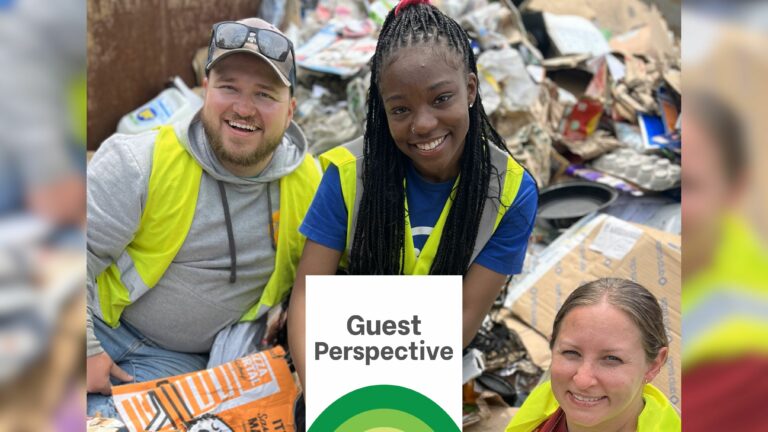
NATALIE JAKUB, IS THE EXECUTIVE DIRECTOR FOR GREEN LIVING SCIENCE, AND A LEADERSHIP COMMITTEE MEMBER FOR SUSTAINABLE BUSINESS NETWORK DETROIT
America Recycles Day held annually on November 15th holds immense importance as it serves as a powerful reminder of the critical role recycling plays in conserving resources, reducing waste, and protecting the environment. This annual observance encourages individuals, communities, and businesses to take concrete steps toward sustainability by pledging to recycle and promoting recycling education and initiatives. It reinforces the idea that recycling is not just a one-time effort but a continuous commitment to creating a greener, more sustainable future for generations to come.
America Recycles Day inspires collective action and underscores that every small recycling act contributes to a significant positive impact on our planet.
For nearly two decades, Detroit has been proactively enhancing residents’ access to recycling services as part of its broader sustainability mission. Acknowledging the importance of diverting recyclable materials from landfills to minimize environmental impact and conserve resources, the city has implemented initiatives such as expanding curbside recycling pickup, improving access to public space recycling, and fostering partnerships with local organizations. These strategic moves aim to make recycling more accessible and convenient for Detroit’s residents, empowering the community to actively participate in sustainable practices and contribute to a cleaner, greener city for all.
At the forefront of Detroit’s sustainability journey stands Green Living Science (GLS), a nonprofit organization dedicated to educating Detroit residents about waste and recycling. Initially established in response to the Detroit Public Schools Community District’s request for recycling and conservation education, GLS has grown to provide a range of educational programs aimed at instigating behavior change for a more sustainable society.

GLS serves Detroit’s 600,000+ residents who have been adversely impacted by the trash, air pollution, and debris pervading communities. The city launched a curbside recycling program in 2015 and contracted GLS to teach residents about recycling and sign them up for free recycling carts. GLS remains the recycling and outreach contractor for the Department of Public Works (DPW), educating residents about recycling services available to them and working closely with block clubs and community groups throughout the city.
One of GLS’s flagship programs, the Bee Green Business initiative, launched in 2014 in response to the corporate sector’s need for effective recycling and waste reduction solutions. This program educates and certifies companies in Southeast Michigan committed to responsible corporate citizenship. By training businesses to establish waste reduction and recycling systems and educating their staff on correct usage, Bee Green Business supports companies in minimizing their environmental footprint. Moreover, it recognizes and celebrates businesses that are leading sustainability in Michigan.
Southeast Michigan, with its historical legacy of manufacturing and innovation, has emerged as a vibrant hub for sustainability initiatives, embracing the principles of responsible business practices. GLS envisions a future for the region where sustainability is integral to business operations, and where companies prioritize environmental impact alongside financial success. To realize this vision, GLS focuses on reducing waste through recycling and composting advocacy, partnering with local businesses to ensure recyclable materials are diverted from landfills, thus reducing the environmental burden.
GLS champions sustainable sourcing practices, encouraging businesses to embrace the circular economy, which minimizes waste and maximizes resource efficiency. These initiatives help bolster the regional economy while diminishing the environmental repercussions of long-distance transportation.
While Southeast Michigan has made significant headway in its sustainability journey, it grapples with challenges stemming from its industrial past, including pollution and environmental degradation. Nevertheless, GLS’s emphasis on circular economy principles and waste reduction contributes to overcoming these challenges and forging a cleaner, more sustainable city.
Remediation and cleanup efforts continue to address these issues. We are seeing businesses adopting
circular economy principles, minimizing waste, and maximizing resource efficiency which will help address and overcome the legacy not dedicated to creating a cleaner city.
Green Living Science plays a pivotal role in Southeast Michigan’s path toward sustainability by serving as a catalyst for change. Through engagement with businesses, schools, and communities, GLS offers valuable resources and educational programs that empower individuals and organizations to embrace sustainable practices.
In conclusion, Southeast Michigan stands as a burgeoning center for sustainable business practices and environmental responsibility. As Southeast Michigan confronts its sustainability challenges and strives to attain its goals, the role of GLS in educating, inspiring, and facilitating change cannot be overstated. Together, Southeast Michigan and GLS are forging a path toward a greener, more sustainable future, benefiting all who call this region home.
Be sure to subscribe to our newsletter for regular updates on sustainable business practices in and around Detroit.



In November 2023, the City of Detroit enacted an Energy and Water Benchmarking Ordinance requiring buildings 25,000 square feet and larger to annually report their energy and water usage to the city. The policy focuses on transparency, giving building owners and city leaders insight into how buildings perform and where opportunities may exist to improve efficiency and reduce costs. SBN Detroit interviewed Maria Galarza, Deputy Director of the...
Detroit-based nonprofit Elevate focuses on the intersection of energy equity, housing stability, and workforce development. Through community partnerships and programs that connect residents with energy-efficiency upgrades, education, and job-training opportunities, the organization works to strengthen neighborhoods while helping families reduce costs and improve living conditions. SBN Detroit interviewed Shawna Forbes Henry, Director of Community Programs at Elevate, about the broader implications of energy access, the structural barriers communities...
The Green Business Lab, founded in 2002 by Samantha Svoboda, aims to help organizations strengthen decision-making about sustainability through immersive business simulations and strategic advisory services. Working with leadership teams across industries, the Lab creates structured environments where executives can explore how environmental, operational, and market forces intersect with core business strategy. Over more than two decades, the Green Business Lab has worked with companies toward moving sustainability...