

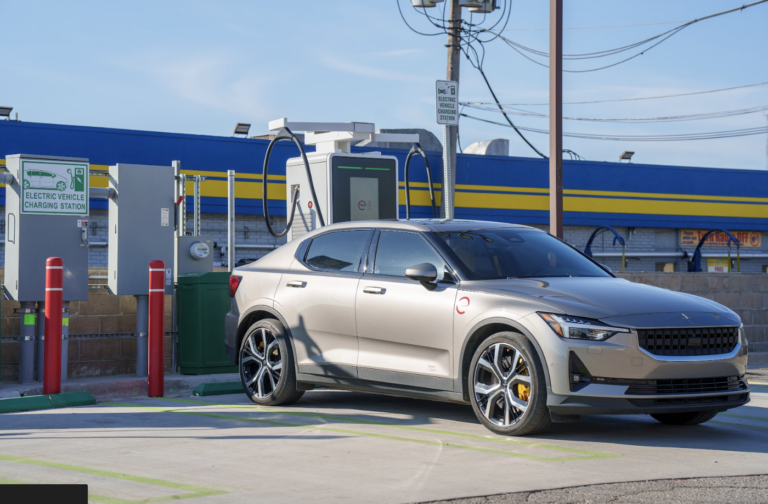
Three years ago, under the Bipartisan Infrastructure Law, Congress allocated $5 billion in federal funding to establish the National Electric Vehicle Infrastructure (NEVI) Program. This initiative aims to develop charger networks across each state to support electric vehicles (EVs). Of this funding, $110 million was earmarked for Michigan, covering the period through fiscal year 2026. However, the state has not yet seen the installation of any new power stations.
As part of this effort, Red E Charging LLC – an EV infrastructure developer and charging network based in Detroit – has been awarded several NEVI contracts to install and manage in Michigan and a number of other states.
SBN Detroit interviewed Red E Charging Founder Abass El-Hage about the timeline, barriers, and factors specific to Michigan regarding power station installation.

Q: Since the announcement in 2021 of the $5 billion in federal funding just 11 EV stations have been installed across seven states, with none in Michigan to date. From your perspective, why is this?
A: There are several reasons.
First, this is a new process and it took time to get organized, generate RFPs, and kick it off. RFPs were published at the end of last year and contracts were awarded early this year.
Setting up the necessary paperwork is tedious and time-consuming, and around public funds, there is just a lot of due diligence required.
There are also multiple and varied requirements around bonding that can take another six months to sort out.
Identifying appropriate locations for the charging stations with the right amenities on the property that’s willing to host can be time-consuming.
On top of that, regardless of how long the paperwork takes, working with the utilities and getting the right equipment and resources in place can take six months to a year.
It’s simply an arduous process that takes time.
Q: Do the requirements vary from state to state?
A: Yes. Every state is different when it comes to execution under NEVI. In Texas and New Mexico, the NEVI process is pretty straightforward, but Texas has issues with utilities that can slow things down.
I would say Michigan is the middle of the road. And the biggest hurdle here is the strict bonding requirements. Not every state requires bonding, but Michigan requires a five-year bond that’s not run of the mill.
Q: Outside of NEVI projects, is every state different?
A: Yes. Incentives are different in every state. Utilities are different. In Michigan, we are lucky to have DTE and Consumers Energy. They have been helpful and proactive, and they facilitate a lot.
EGLE (Michigan Department of Environment, Great Lakes, and Energy) and the EPA have been helpful in Michigan as well, helping to create infrastructure in off-highway locations that are still easily accessible at reasonable rates.
Q: In Michigan, are the challenges different in the Upper Peninsula compared with the Lower Peninsula?
A: Yes. With every project there are financials, and in the UP there are fewer people, there is less traffic, and therefore less charger usage. It’s harder to justify a project when you don’t make the money back as fast.
Additionally, utilities in the Upper Peninsula impose demand charges, which are flat fees added to the electric bill. These charges can be quite substantial. When considering these costs, the financial viability of a project often becomes questionable.
Q: How do you view the transition from gas to electric vehicles being understood and received by the public?
A: It’s a mixed bag. I think there is still a stigma around charging and how difficult and inconvenient it could be. It’s a misconception in my opinion. I drive from Detroit to Chicago regularly and along that route, I can stop to charge just like stopping for gas.
Also, I think there’s been mixed messaging to the public by the auto industry – especially here in Detroit. When there are recalls, or if an automaker commits to building x amount of EVs and then scales back, this sends mixed signals to the public.
Q: How many contracts in Michigan has Red E Charging been awarded and what is the status?
A: We’ve been awarded 12 NEVI contracts all over the state and an additional 60 fast charger projects across the state for EGLE and utilities.
As I explained, the paperwork along with bonding requirements plus environmental approvals, site checks, and more make this a slow process. But we have notice to proceed and are moving forward with the first few now, so these will be underway. The actual installation takes just about two weeks.
We were also awarded a project outside of NEVI with the City of Detroit to install public-facing chargers throughout the city.
Q: Michigan aims to have enough infrastructure for 2 million EVs on the roads by 2030. Do you think this is possible?
A: Yes, I think it can happen. DTE and Consumers Energy are very helpful when it comes to single-family and multifamily homes. It’s cost-effective to have a charger at your home.
That drive from Chicago to Detroit I talked about … I think by the end of the year there will be chargers every 20 miles or so, eliminating any planning needed because people will feel confident they can stop whenever they need a charge.
I think in the near future the logistics involved in an EV experience will be no different than driving a gas-powered vehicle. It’s just a different thing fueling the car.



In November 2023, the City of Detroit enacted an Energy and Water Benchmarking Ordinance requiring buildings 25,000 square feet and larger to annually report their energy and water usage to the city. The policy focuses on transparency, giving building owners and city leaders insight into how buildings perform and where opportunities may exist to improve efficiency and reduce costs. SBN Detroit interviewed Maria Galarza, Deputy Director of the...
Detroit-based nonprofit Elevate focuses on the intersection of energy equity, housing stability, and workforce development. Through community partnerships and programs that connect residents with energy-efficiency upgrades, education, and job-training opportunities, the organization works to strengthen neighborhoods while helping families reduce costs and improve living conditions. SBN Detroit interviewed Shawna Forbes Henry, Director of Community Programs at Elevate, about the broader implications of energy access, the structural barriers communities...
The Green Business Lab, founded in 2002 by Samantha Svoboda, aims to help organizations strengthen decision-making about sustainability through immersive business simulations and strategic advisory services. Working with leadership teams across industries, the Lab creates structured environments where executives can explore how environmental, operational, and market forces intersect with core business strategy. Over more than two decades, the Green Business Lab has worked with companies toward moving sustainability...