

The Energy Alliance Group of North America focuses on helping businesses implement sustainable energy solutions by identifying opportunities for improved efficiency and connecting clients to funding and technology. Based in Ann Arbor, Michigan, the company collaborates with commercial and industrial property managers to reduce energy consumption, enhance operations, and achieve long-term cost savings.
SBN Detroit interviewed Scott Ringlein, founder, principal, and Chief Strategy Officer, about energy efficiency in Southeast Michigan, the role of financing and audits, and the importance of long-term thinking when it comes to sustainability.

Q: What are the biggest energy efficiency challenges facing commercial and industrial buildings in Southeast Michigan?
A: Misinformation is one of the biggest challenges. Every building has the opportunity to implement energy efficiency improvements, and there is money available to make it happen.
These improvements offer a return on investment, but many building operators and owners either don’t believe the numbers or assume they don’t apply to them. The truth is, utility costs are ongoing and only getting higher, so the only way to gain control is to improve your building’s efficiency.
Q: How can businesses identify when it’s time to upgrade or retrofit their energy systems
A: Start by knowing what you have—what systems are in place, their expected lifespan, and their maintenance history. If you’re seeing frequent repairs and higher maintenance costs, it’s time to look at alternatives.
Then evaluate how much more efficient a new system could be and what kind of energy savings it could deliver. If the numbers make sense, that’s the signal to move forward. Unfortunately, many businesses struggle with that last step—deciding to invest.
Q: What misconceptions do you commonly encounter around cost recovery or energy savings?
A: Many building owners don’t believe the projections—even when we show them data that supports a positive cash flow within one or two years. They tend to focus solely on ROI and forget that utilities never go away. You’re always going to pay for water, electricity, gas—whatever it is. And the utility companies have no vested interest in lowering your costs. So even if you’re skeptical, you’re still going to be paying more year after year unless you act.
Q: How has the financing landscape changed for energy upgrades—especially for nonprofits or small businesses?
A: We’ve been in this space since 2012, and the financing options today are better than they’ve ever been. Tax credits will come and go, but there are more long-term tools now than there were a decade ago. Michigan has been a leader in this area.
Programs like Michigan Saves were the first of their kind in the U.S. We’re also a state approved for Property Assessed Clean Energy (PACE) financing, although it’s underutilized here compared to states like California. Still, the options are out there—you have choices, and you can take control.
Q: What role do energy audits play in long-term planning, and how often should they be conducted?
A: Audits are essential. You need to know where you stand—what equipment you have, how efficient it is, and what condition it’s in. It’s surprising how many clients have never even been on their own roof, where all the major equipment is housed.
There are different levels of audits. A Level 1 audit gives you a basic understanding of what you have and where you’re spending your money. A Level 3 audit goes deeper and is useful when you’re preparing to make major decisions—like process changes or equipment replacement.
A challenge is that many companies don’t take the time for a comprehensive audit until it’s too late. Smaller organizations may lack the staff, and larger ones may lose visibility due to scale. But without that baseline, long-term planning is difficult.
Q: How do Southeast Michigan’s climate swings shape energy strategy in the region?
A: As an organization, we don’t use climate change as the primary argument for doing the right thing. Climate change is happening, but we believe the conversation around energy efficiency should be happening regardless. You’re spending money on utilities – and there are better systems and more efficient ways to operate.
We also need to think long-term. In the U.S., we don’t treat these upgrades as long-term investments the way they do in Europe or Asia. There, the systems are central to the building’s value and are maintained accordingly. Here, we often focus too much on short-term costs instead of building for performance and sustainability.
Q: What advice do you have for businesses looking to reduce costs and improve operations going forward?
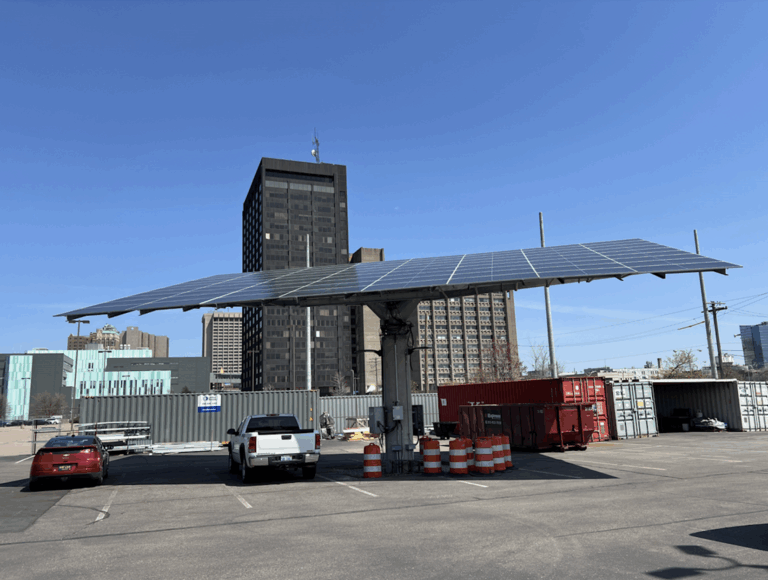
A: Real-time monitoring of building systems from a central location gives you visibility and control. Beyond that, the cost of implementing technologies like LED lighting, heat pumps, solar panels, and combined heat and power (CHP) systems has become very feasible.
There are also integrated systems now—solar light poles with battery storage and surveillance, for example—that operate independently of utility companies. The key is maintenance. These systems don’t last forever if they’re neglected. But with built-in monitoring and upkeep, they can be powerful tools for cutting costs and improving resilience.
Be sure to subscribe to our newsletter for regular updates on sustainable business practices in and around Detroit.




In November 2023, the City of Detroit enacted an Energy and Water Benchmarking Ordinance requiring buildings 25,000 square feet and larger to annually report their energy and water usage to the city. The policy focuses on transparency, giving building owners and city leaders insight into how buildings perform and where opportunities may exist to improve efficiency and reduce costs. SBN Detroit interviewed Maria Galarza, Deputy Director of the...
Detroit-based nonprofit Elevate focuses on the intersection of energy equity, housing stability, and workforce development. Through community partnerships and programs that connect residents with energy-efficiency upgrades, education, and job-training opportunities, the organization works to strengthen neighborhoods while helping families reduce costs and improve living conditions. SBN Detroit interviewed Shawna Forbes Henry, Director of Community Programs at Elevate, about the broader implications of energy access, the structural barriers communities...

The Green Business Lab, founded in 2002 by Samantha Svoboda, aims to help organizations strengthen decision-making about sustainability through immersive business simulations and strategic advisory services. Working with leadership teams across industries, the Lab creates structured environments where executives can explore how environmental, operational, and market forces intersect with core business strategy. Over more than two decades, the Green Business Lab has worked with companies toward moving sustainability...