

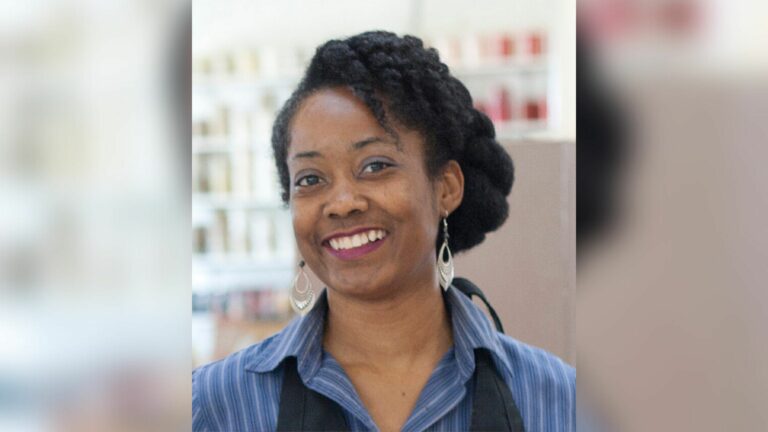
In 2013, industrial designer Shayla Johnson launched Scarlet Crane Creations and began selling her stationery and other prints at The Rust Belt Market in Ferndale. She quickly realized her disdain for using paper as a medium due to the waste it created. Pivoting to natural and organic fabrics and eco-friendly inks, she created her Detroit Collection which includes home décor and accessories made from original and sustainable hand-printed fabrics.
Over the next eleven years, she progressed her sustainability practices and is now revamping her systems, equipment, and space toward the preservation of water and the support of using organic dyes and materials.
SBN Detroit interviewed Johnson about the impetus behind her vision, the challenges in executing sustainable practices in the print and textile industry, and the solutions she is employing.
Q: What is the company’s approach to sustainability?
A: Sustainability is always a thread in my thinking and I’m always looking for ways to do better. I’ve progressed from paper to fabric to more responsible fabric and continue this evolution. I use all organic and eco-friendly inks. We are also focused on a closed-loop system that allows us to recycle the water we use.
Q: What inspired you to focus on your water usage, and what are the challenges in the printing/textile industry that you face regarding this?
A: At one point along the way I measured how much water I was using in one print session, and it was ten gallons. To put this in perspective, that involved dying about ten to 15 yards of fabric. I saw this as completely problematic, watching all that water go down the drain. And began to think exponentially – what does this look like across the country and globe?
I have come to find out that the global textile industry utilizes 1.3 trillion gallons of water annually – enough to fill 2 million Olympic-sized pools.
Q: What did you do next?
A: Water-based inks have always been my focus. I knew that going forward when I dump the waste, I needed to make sure it was filtered and disposed of properly and the water was reused.

I began working with Centrepolis, and they connected me to Dr. Refael Aharon, an expert in textile recycling. We worked for four months studying my processes and developed a system that he outlined for me including recommendations and the equipment and type of space I will need.
Q: You recently won a $10K grant from Michigan Women Forward to expand your space to accommodate this. What has this involved?
A: That’s right. I am part of the Motor City Match program now and am in the development track, where I’m getting help to further plan the space and secure a location.
Q: You utilize fabrics that are sourced in the U.S. and the production is focused locally in Detroit. What challenges come with this?
A: The companies we order from are all American-based companies, and it is all organic cotton and linens, etc. But there are very few mills in the U.S. these days, so some of the raw goods are unfortunately imported.
The companies we buy from all have a commitment to sustainability, and I try to purchase as much fabric as I can locally. Our bread-and-butter product – tea towels – is from a fabric company in Michigan.
Q: What are the challenges in working with organic inks and dyes?
A: Using natural dyes requires a different process that is more labor-intensive and therefore takes longer. These dyes are made from plants and proteins that come from cactuses and other natural sources and can be more expensive to source.
Since they are all-natural, they don’t last as long. We have to use them faster and that can be tricky to manage.
So, the biggest barrier becomes being able to produce in a way that still allows us to sell the products at a reasonable price.
However, my clients appreciate and seek out these products purposefully, choosing not to purchase ink that requires solvents and materials made of synthetics, etc. So, they are not surprised by higher price points.
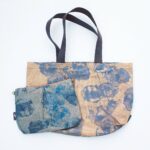
This model aligns with slow fashion – being thoughtful and intentional about the outcome even if that takes longer. I believe in having an item that will last longer and that won’t end up in a landfill.
Q: Are there additional sustainability practices you deploy?
A: Some of our items are created from upcycled materials like jeans and pre-owned items.
People also like these because they are one-of-a-kind.
Q: In terms of sustainability – does your location in Detroit come into play?
A: Yes. Because there has been a resurgence of interest around Detroit and people are looking to focus efforts in this area, that has helped. People want to support us.
My assistant is a College for Creative Studies graduate, and I want to continue to train students locally who have a passion for fibers and sustainability around textiles. I want to keep all of that within the Detroit ecosystem.
Q: What are the barriers you have faced operating sustainably as a smaller company?
A: The inability to work as quickly as we’d like.
Also, the dyes I mentioned. Some only last two to three weeks, so we try to print as much as we can in a few sessions before the vat goes bad.
Organic materials can be unstable. You constantly must keep them fresh.
Q: What is your advice to other design/textile companies like yours when it comes to sourcing locally to help the economy and be more sustainable?
A: I believe in collaboration, especially with local schools and universities. I think sticking to a local pipeline of talent is important.
I work as an adjunct at CCS, and it’s really been useful to me to bounce ideas off of others. My advice is to never work in a silo – build a community.
To that end, I belong to a couple of community printmakers in the area and have been deeply supported by Ocelot Print Shop and Signal Return. Their commitment to empowering local printmakers is fantastic and has helped me – and many others – make my vision a reality.
Be sure to subscribe to our newsletter for regular updates on sustainable business practices in and around Detroit.



In November 2023, the City of Detroit enacted an Energy and Water Benchmarking Ordinance requiring buildings 25,000 square feet and larger to annually report their energy and water usage to the city. The policy focuses on transparency, giving building owners and city leaders insight into how buildings perform and where opportunities may exist to improve efficiency and reduce costs. SBN Detroit interviewed Maria Galarza, Deputy Director of the...
Detroit-based nonprofit Elevate focuses on the intersection of energy equity, housing stability, and workforce development. Through community partnerships and programs that connect residents with energy-efficiency upgrades, education, and job-training opportunities, the organization works to strengthen neighborhoods while helping families reduce costs and improve living conditions. SBN Detroit interviewed Shawna Forbes Henry, Director of Community Programs at Elevate, about the broader implications of energy access, the structural barriers communities...
The Green Business Lab, founded in 2002 by Samantha Svoboda, aims to help organizations strengthen decision-making about sustainability through immersive business simulations and strategic advisory services. Working with leadership teams across industries, the Lab creates structured environments where executives can explore how environmental, operational, and market forces intersect with core business strategy. Over more than two decades, the Green Business Lab has worked with companies toward moving sustainability...