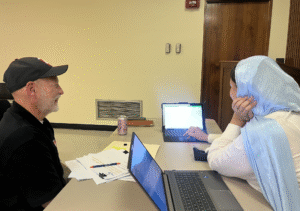


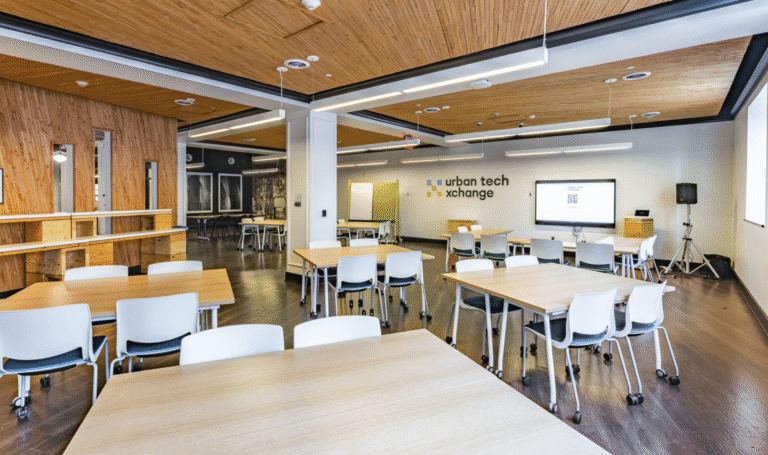
Now in its fourth year of operation, Urban Tech Xchange (UTX) has become a living laboratory where emerging technology startups can test, refine, and validate smart urban systems in real-world conditions. Launched through a collaboration between Bedrock, Bosch, Cisco, and Kode Labs, UTX builds on the foundation of the Detroit Smart Parking Lab (founded earlier by Bedrock, Ford, MEDC, and Bosch) expanding its scope beyond parking into logistics, energy, building automation, accessibility, and freshwater tech.
What differentiates UTX from other technology incubators and accelerators is its emphasis on real-world deployment. Rather than testing concepts in isolation, startups pilot technologies directly within Detroit’s streets, curbsides, buildings, and rooftops, allowing solutions to be measured against real constraints such as emissions reduction, infrastructure utilization, and resident impact. Over the past four years, that approach has helped deploy dozens of pilots and move some into active use.
SBN Detroit interviewed Kevin Mull, Bedrock’s Senior Director for Strategic Initiatives, about how Southeast Michigan’s legacy industries are shaping the next era of sustainable urban logistics—and how incremental efficiencies can deliver meaningful environmental gains at city scale.

Q: What factors help position Southeast Michigan to rethink how urban logistics can improve daily life in cities like Detroit?
A: Southeast Michigan has been designing, building, and deploying mobility solutions for generations. What’s different right now is that we’re at a special moment where the relationships, the talent, and the physical space all align. We have room to test ideas, and we have strong public-private partnerships that allow us to deploy technology.
Bedrock’s Detroit Smart Parking Lab (DSPL) and Urban Tech Xchange (UTX) give startups the ability to move beyond theory. Through platforms like the Michigan Mobility Funding Platform, we’ve been able to deploy a million dollars in grants to early-stage companies tackling real logistics and mobility challenges. Over the past four years, several of those pilots have become production-ready solutions now operating across Detroit—from curbside EV charging to streetlight-mounted charging systems.
Q: How do wasted miles, underused infrastructure, or inefficient logistics affect urban environments and quality of life?
A: Wasted miles translate directly into congestion, emissions, and frustration. Vehicles circling for parking, trucks idling in residential areas, or delivery vehicles double-parking because curb space isn’t managed well—all of that erodes the day-to-day experience of a city.
Underutilized infrastructure is another big issue. Curbsides, loading zones, rooftops—these are valuable assets that often aren’t managed intentionally. At Bedrock alone, we process roughly 100,000 parking transactions per month. Every single one of those transactions is an opportunity to reduce friction or create value.
We are focusing on solutions that remove friction. One example is IONDynamics, that’s working on automated EV charging. Another is HEVO – a wireless charging solution. Small improvements, repeated thousands of times, add up quickly.
Q: How do smarter logistics systems change the way residents experience sustainability day to day?
A: Sustainability becomes tangible when it improves daily life. Fewer vehicles circling means cleaner air and quieter streets. Better-managed loading zones mean safer sidewalks. More predictable deliveries mean less congestion during peak hours.
One pilot we ran used a small autonomous robot to transport food scraps between restaurants and upcycling locations. Over the course of that project, it diverted more than 2,600 pounds of food waste and eliminated nearly 1,200 pounds of greenhouse gas emissions by replacing traditional vehicle trips. It also avoided the use of about 56 gallons of fuel.
Those numbers matter, but what residents notice is the absence of friction—less noise, less traffic, and fewer large vehicles in tight residential spaces. Sustainability works best when it’s embedded into systems people already rely on.
Q: How can improved last-mile logistics help reduce unnecessary driving and strengthen neighborhood connectivity?
A: The last mile is one of the most important parts of the logistics chain and is often the most inefficient. A lot of energy is going into that space right now because it has outsized impact.
Better coordination of curb space, smarter delivery scheduling, and multimodal solutions all reduce the need for unnecessary trips. When people can reliably park, receive deliveries, or access transit without friction, neighborhoods become more functional and connected.
We focus on the edges—where parking garages meet transit, where delivery vehicles meet sidewalks, where people move between modes. Improving those interfaces creates meaningful gains without massive infrastructure investments.
Q: Many of the technologies supported by UTX reduce congestion and emissions. How do you think about sustainability in this work?
A: Sustainability is an outcome of better systems rather than the starting point. When you reduce wasted miles, idle time, and inefficient use of infrastructure, the environmental benefits follow naturally.
If we can take miles off the street, shorten dwell times, or make curb space and parking more productive, we reduce emissions without asking people to change their behaviors.
Across the Bedrock portfolio, we also think a lot about avoided infrastructure. For example, we’re exploring automated valet parking technology start-ups that aim to allow cars to park closer together and improve garage efficiency by an estimated 20 percent. That can delay—or eliminate—the need to build new parking structures, which has a significant embodied carbon impact.
Another example is an automated robot charging solution from Ion Dynamics, which has a charging robot move to the vehicles require charging, which is a dynamic solution that avoids adding costly fixed charging infrastructure.
The same logic applies to delivery drones, ground-based robots, and micro-mobility. Moving packages through the air or via small electric vehicles instead of gas-powered trucks reduces fuel consumption and congestion.

Q: Where do you see the biggest opportunities for Southeast Michigan cities to improve logistics in ways that benefit both residents and businesses?
A: The opportunities are everywhere, but they’re often measured in inches rather than miles. Smarter curbside management. Better coordination between delivery systems and transit hubs. More efficient use of shared infrastructure.
Individually, these improvements may seem small. But in the aggregate, they have outsized impact. Through platforms like UTX and DSPL, we’re helping startups test those ideas, refine them, and scale what works.
Q: Looking ahead five to ten years, what would a more livable Detroit look like if urban logistics worked better?
A: A more livable Detroit is one where sustainability is built into the background of daily life. Fewer emissions on residential streets. More efficient use of existing buildings and infrastructure. Cleaner air, safer sidewalks, and systems that feel intuitive rather than disruptive.
We’re realistic – some of the pilot testing at UTX and DSPL won’t scale and that is the point of having testing labs. But over the past four years, we’ve helped deploy more than 25 mobility and logistics solutions, many of which are now informing real-world operations. If we can continue to facilitate and introduce five to ten new technologies in the market per year, those incremental gains will compound.
Over time, that means fewer emissions, less need for new construction, and a city that strategically uses what it already has in place. That’s the kind of sustainability that lasts—because it’s practical, measurable, and experienced by residents every day.
Be sure to subscribe to our newsletter for regular updates on sustainable business practices in and around Detroit.



In November 2023, the City of Detroit enacted an Energy and Water Benchmarking Ordinance requiring buildings 25,000 square feet and larger to annually report their energy and water usage to the city. The policy focuses on transparency, giving building owners and city leaders insight into how buildings perform and where opportunities may exist to improve efficiency and reduce costs. SBN Detroit interviewed Maria Galarza, Deputy Director of the...
Detroit-based nonprofit Elevate focuses on the intersection of energy equity, housing stability, and workforce development. Through community partnerships and programs that connect residents with energy-efficiency upgrades, education, and job-training opportunities, the organization works to strengthen neighborhoods while helping families reduce costs and improve living conditions. SBN Detroit interviewed Shawna Forbes Henry, Director of Community Programs at Elevate, about the broader implications of energy access, the structural barriers communities...

The Green Business Lab, founded in 2002 by Samantha Svoboda, aims to help organizations strengthen decision-making about sustainability through immersive business simulations and strategic advisory services. Working with leadership teams across industries, the Lab creates structured environments where executives can explore how environmental, operational, and market forces intersect with core business strategy. Over more than two decades, the Green Business Lab has worked with companies toward moving sustainability...